On November 16, 2025, Luo Qingming, Member of the Chinese Academy of Sciences (CAS) and President of Hainan University (HNU), and Wang Chi, Member of CAS and Director of the National Space Science Center of the Chinese Academy of Sciences, signed a Memorandum of Understanding (MoU), representing the Secretariat of the League of Tropical Universities and the International Meridian Circle Big Science Program respectively. The signing laid a solid foundation for the widespread participation of member institutions of the League of Tropical Universities in this major international big science program initiated by Chinese scientists.
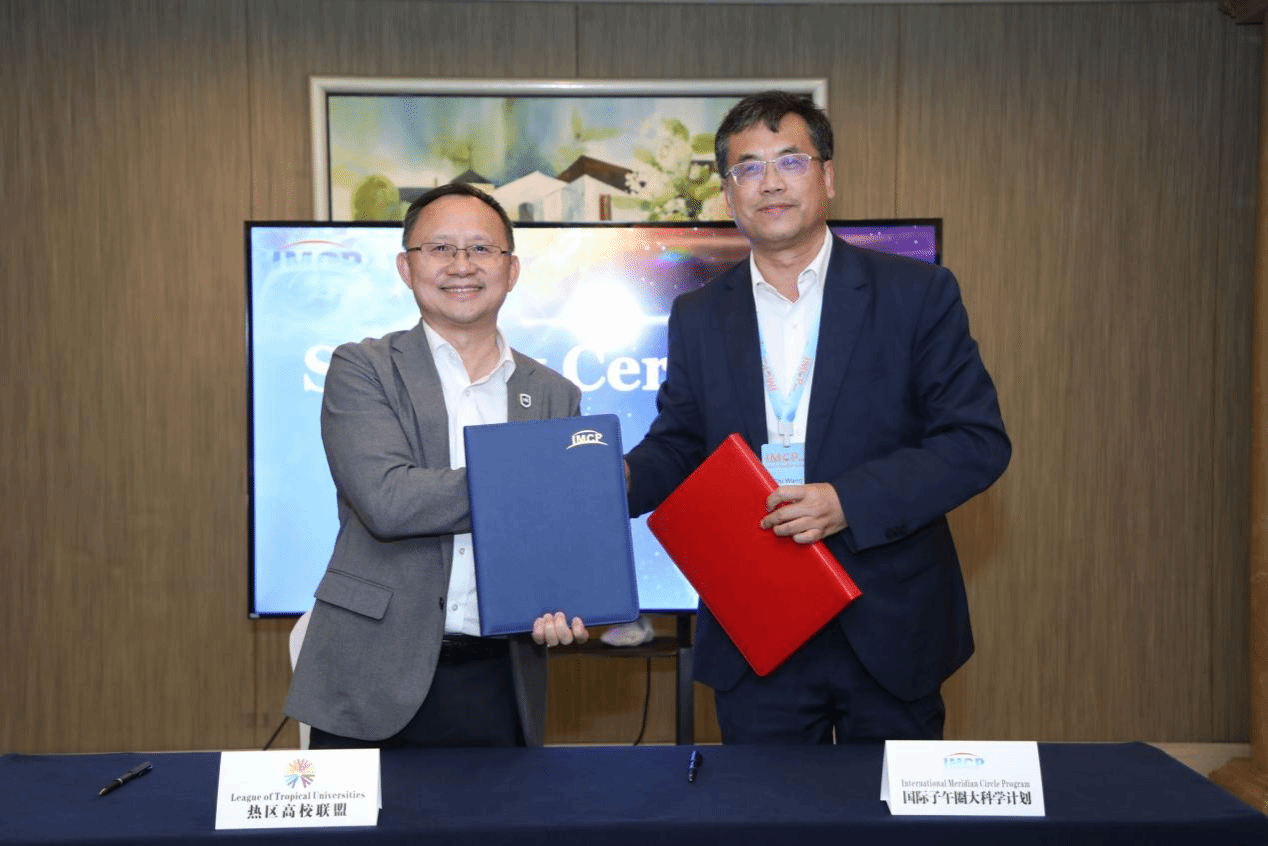
Luo Qingming, Member of CAS and President of HNU, signs the MoU on behalf of the Secretariat of the League of Tropical Universities.
The core of the International Meridian Circle Big Science Program is the construction of a ground-based space weather monitoring network encircling the Earth along the 120°E and 60°W meridians. This configuration is designed to leverage the Earth’s rotation to conduct all-weather, full-latitude 3D scanning of the solar-terrestrial space—namely the “fourth environment” that is closely linked to human space exploration. Through this global observation network, the program will focus on investigating the mechanisms and propagation patterns of hazardous space weather events, in order to address the threats they pose to critical infrastructure such as satellites, communications, and navigation systems.
The construction of “Chinese Meridian Project”—a major national scientific and technological infrastructure—has provided a solid core foundation for this international initiative. The robust monitoring capabilities, independently developed advanced equipment, and a team of specialized talents cultivated during Phase II of the Meridian Project will serve as important support for international joint observation and research.
The signing of the MoU marks an important step in advancing the participation of the global scientific and technological community. At present, dozens of international research institutions have expressed their intent to collaborate. Looking ahead, the program aims to establish an open international cooperation platform, bringing together scientists worldwide to conduct long-term joint observations and research, thereby enhancing humanity’s capacity to predict and respond to space weather hazards and providing scientific support for the safe exploitation and utilization of space resources.
English Translator: Li Yang
Proofread by Zhu Yan