A joint research team from Hainan University (HNU) and Huazhong University of Science and Technology (HUST) has developed BrainCAD — a brain-wide cellular architectural deconstruction platform specifically for small animals, and produced the first-ever 3D whole- brain atlas of 20 key cell types in mice.
The study, led by CAS Academician Luo Qingming, Professors Li Xiangning and Li An’an, was published on November 19, 2025, in the journal Nature Communications. The breakthrough reveals the neural signaling balance mechanism between the cerebral cortex and cerebellum, offering a unified and reliable reference for brain science research.
In the mammalian brain, the location and organization pattern of neurons determine circuit operation. Yet, technical limitations have hindered granular, brain-wide analysis. To address this challenge, the team utilized transgenic mice and fMOST imaging, achieving sub-micron resolution images of the entire mouse brain with unprecedented clarity and data integrity.
The BrainCAD platform is specifically developed to effectively detect and identify all fluorescently labeled cells across the entire mouse brain, precisely register them to a standardized brain coordinate framework, and ultimately construct a high-resolution 3D whole-brain atlas of 20 key cell types.
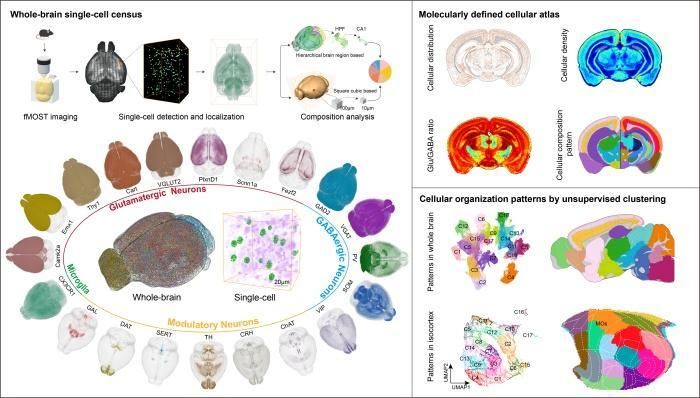
BrainCAD and 3D Whole Mouse Brain Atlas Showing the Distribution of 20 Key Cell Types (Image courtesy of the interviewee)
Leveraging high-resolution cellular distribution data and unsupervised clustering algorithm, the team first divided the entire mouse brain into 3D, equidistant, uniformly sized cubic grids, and grouped distinct regions into hierarchical clusters. The resulting clusters were then mapped to the Allen Mouse Brain Common Coordinate Framework (CCFv3). This innovative bioinformatics approach uncovered an intricate three-dimensional organization within known brain regions, suggesting the presence of finer functional zones.
Furthermore, whole-brain integrative analysis revealed that the cerebral cortex is biased toward excitatory neural signaling, whereas the cerebellum exhibits inhibitory dominance. This signaling balance opens up new research directions for understanding brain disorders.
Prof. Li An’an noted that this achievement bridges the global gap in the development of whole brain atlases at single-cell resolution, shifting the paradigm in brain sciences from macroscopic description to fine-grained analysis.
He also added that the BrainCAD platform and its open-access datasets hold remarkable scientific value and promising clinical translation potential in decoding neural circuits, investigating brain disorder etiology, and identifying drug targets.
Translated by Huai Beibei
Proofread by Jin Ying