On the morning of December 31, the 55th Distinguished Scientist Lecture was held in the lecture hall of the Social Sciences Building at Hainan University. Ding Hong, a member of the Chinese Academy of Sciences and Chair Professor at the Tsung-Dao Lee Institute, Shanghai Jiao Tong University, delivered a keynote report titled “Steel steeds and frozen stream in my dreams: Quantum Computing Transistors”. Li Hu, Chairman of the Hainan University Council, Luo Qingming, Member of Chinese Academy of Sciences and President of Hainan University, Zhang Jiyou, Executive Deputy Chair of HNU Council, and other HNU leaders were in attendance.
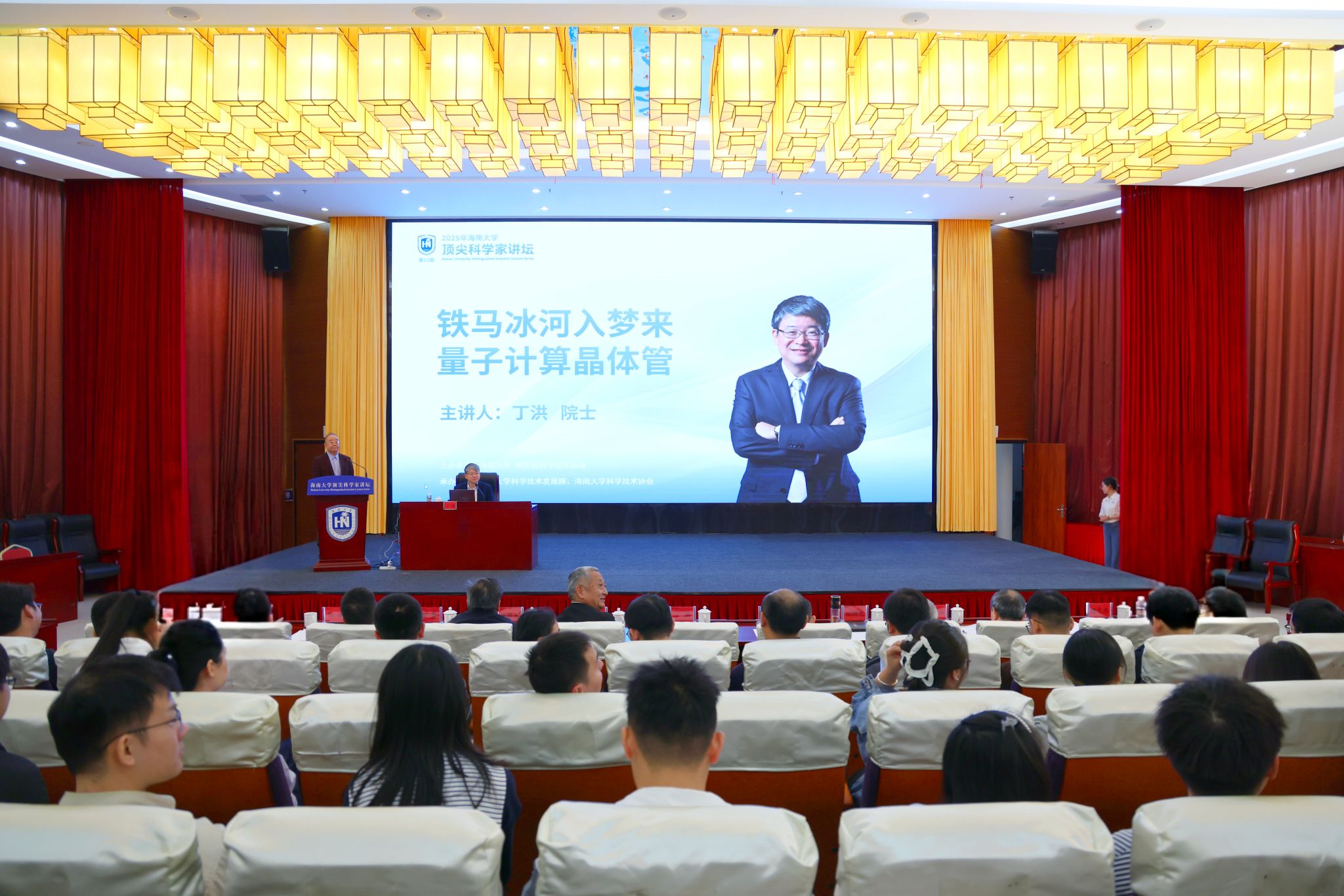
On the morning of December 31, the 55th Distinguished Scientist Lecture of Hainan University is held in the lecture hall of the Social Sciences Building. (Photo by Feng Mengfan)
Ding Hong started his talk by delving into the history of the invention of transistors, the core components of classical computing. He traced the converging development of the semiconductor and computer industries, and then introduced the core advantages and key challenges of quantum computing. Focusing on the principle of quantum superposition and quantum parallelism, he systematically presented mainstream technical solutions such as superconducting qubits and ion traps, and analyzed the persistent problem of high error rates in conventional quantum computing.
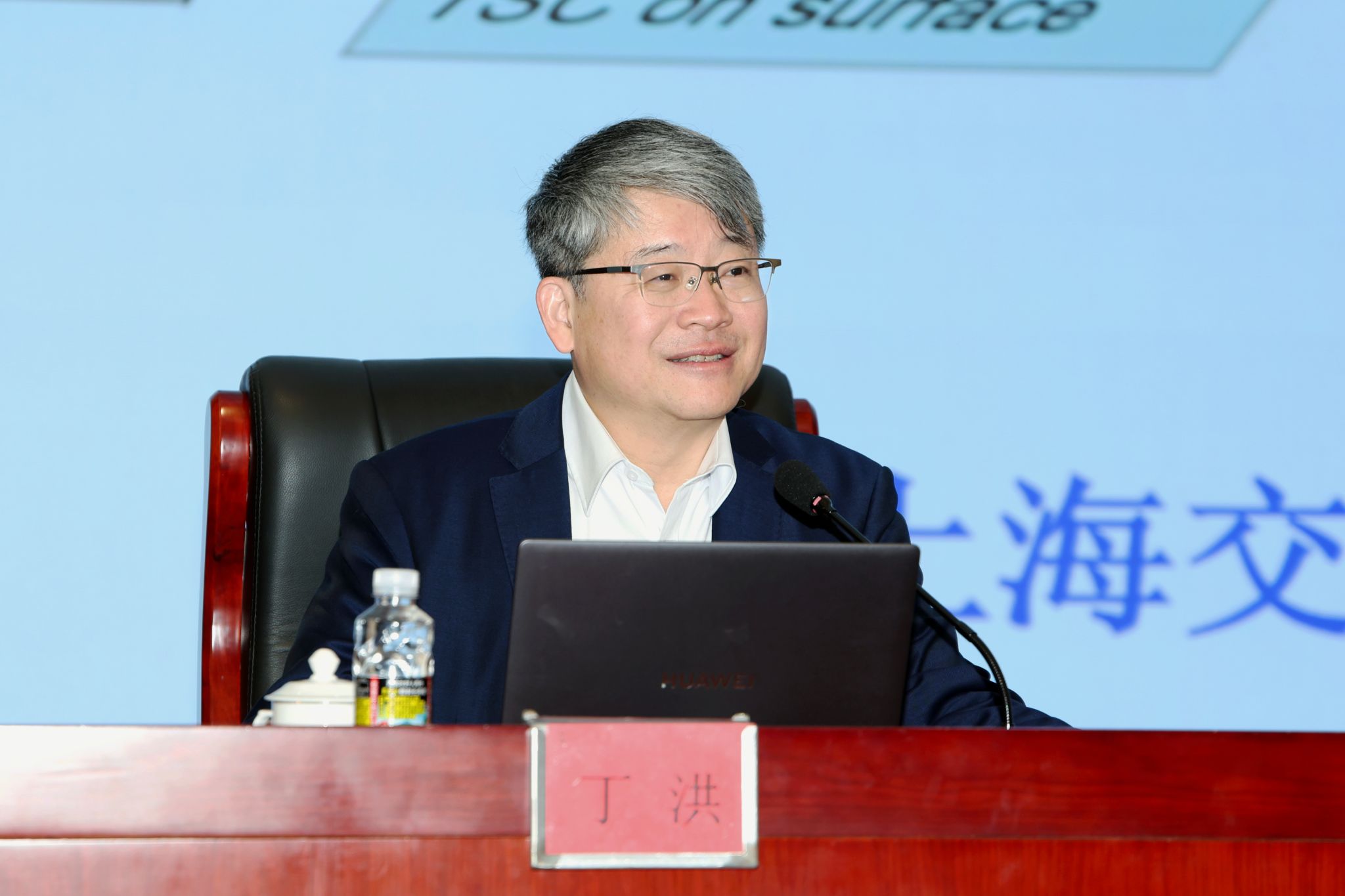
On the morning of December 31, the 55th Distinguished Scientist Lecture of Hainan University is held in the lecture hall of the Social Sciences Building. Ding Hong delivers the report. (Photo by Feng Mengfan)
Drawing on his team’s research achievements, Ding Hong provided an in-depth interpretation of the underlying logic of topological quantum computing. He explained key concepts such as Majorana fermions and anyons, shared the research process leading to the discovery of topological quantum states in iron-based superconductors, and proposed an innovative scheme to construct the “Steel Steed” platform based on iron-based superconducting materials to realize topological qubits. He pointed out that topological quantum computing, leveraging topological protection, can achieve quantum error correction at the hardware level, offering a new pathway to addressing the problem of quantum decoherence. Due to their unique band structures and physical properties, iron-based superconductors have emerged as an ideal materials system for topological quantum computing.
“My ‘Steel Steed Dream’ is to create the transistor for quantum computing,” Ding Hong concluded his talk. He ended with a line from a poem by the Southern Song Dynasty poet Lu You: “At night, wind whips the rain while I there lie; In dream, o’er frozen stream steel steeds trot by” delivering a remarkable lecture that combined academic depth with the warmth of ideals to the faculty and students in attendance.
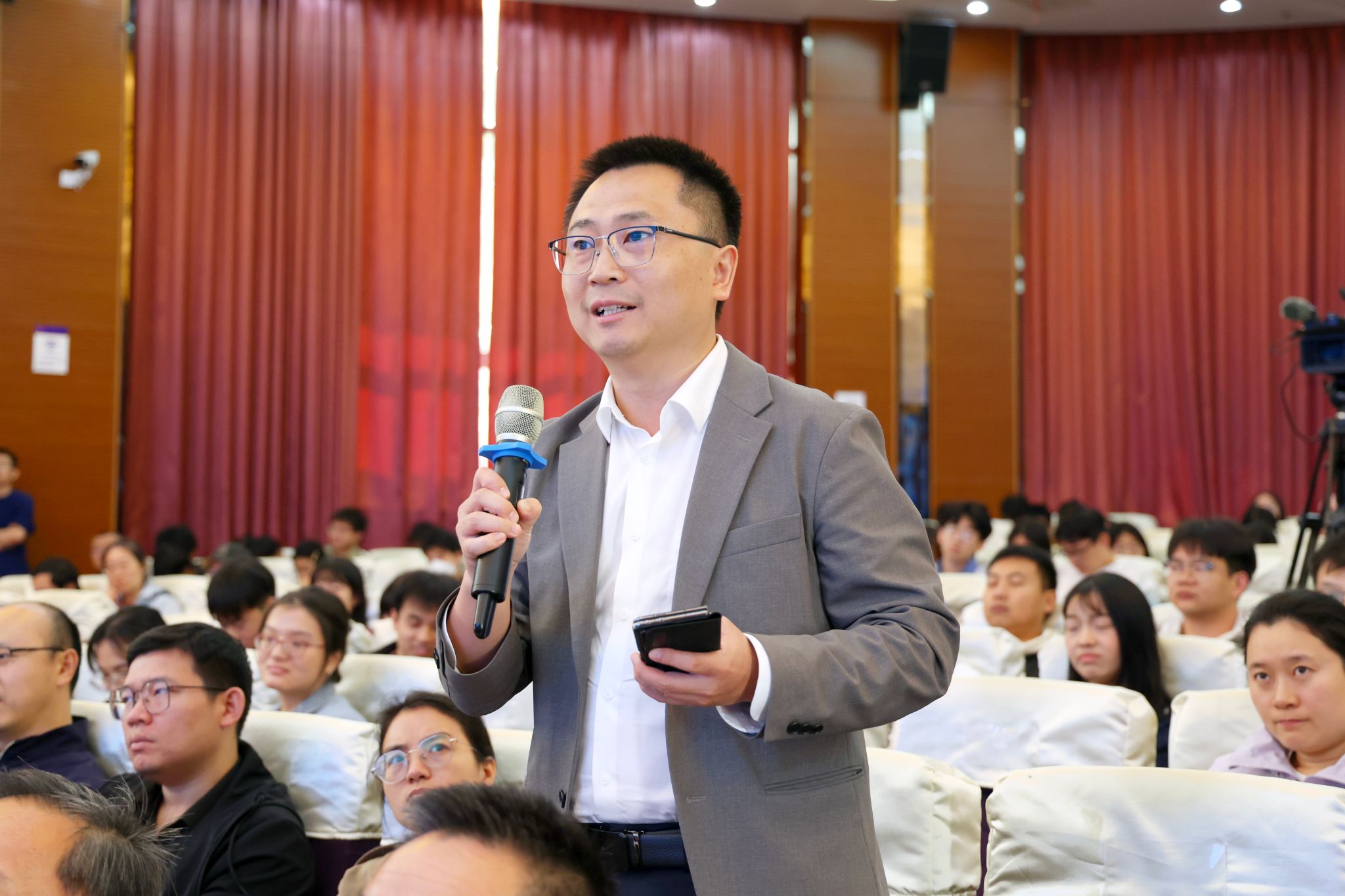
On the morning of December 31, the 55th Distinguished Scientist Lecture at Hainan University is held in the lecture hall of the Social Sciences Building. Faculty and students raises questions. (Photo by Gao Kehe)
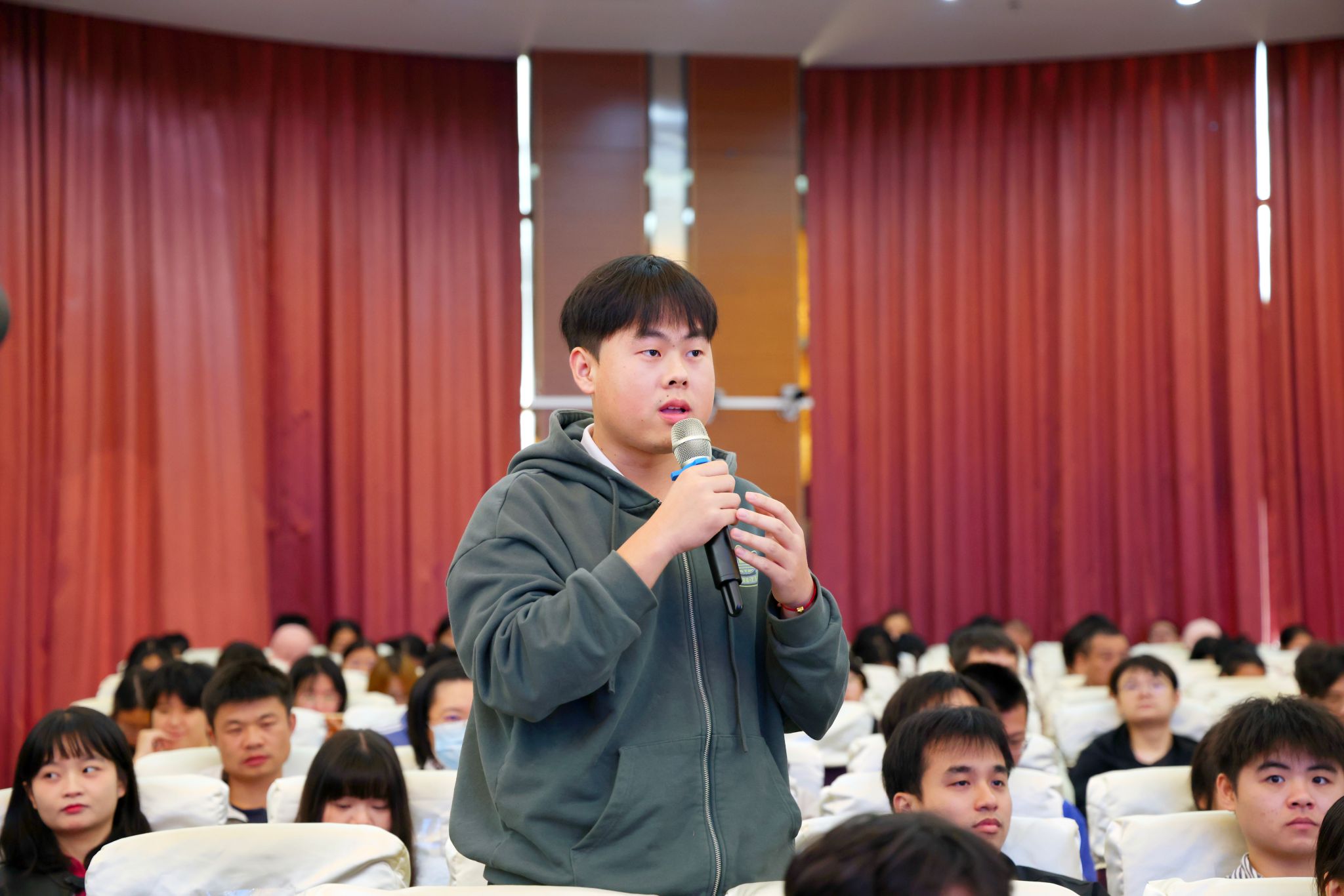
On the morning of December 31, the 55th Distinguished Scientist Lecture at Hainan University is held in the lecture hall on the second floor of the Social Sciences Building. Faculty and students raise questions. (Photo by Feng Mengfan)
The lecture featured enthusiastic interactions at the venue. Faculty and students actively posed questions on issues such as bottlenecks in key materials for quantum computing, the feasibility of room-temperature superconductivity, and quantum state measurement methods. Ding Hong addressed each question in turn with professional expertise.
Officials from the Hainan Association for Science and Technology, heads of relevant units and departments at Hainan University, as well as faculty and students from HNU’s four campuses—Haidian, Danzhou, Mission Hills (including the Chengxi Teaching Site) and Yazhou, participated in the lecture both online and on site.
Translated by Lin Junjun
Proofread by Wang Kexian
English version
HNU Holds 55th Distinguished Scientist Lecture
2025.12.31 21:47
News Brief (By Feng Mengfan and Gao Kehe) — On the morning of December 31, the 55th Distinguished Scientist Lecture was held in the second-floor lecture hall of the Social Sciences Building at Hainan University. Ding Hong, a member of the Chinese Academy of Sciences and Chair Professor at the Tsung-Dao Lee Institute, Shanghai Jiao Tong University, delivered a keynote report titled “Into Dreams of Iron Cavalry and Frozen Rivers: Quantum Computing Transistors.” Li Hu, Party Secretary of Hainan University, Luo Qingming, Member of Chinese Academy of Sciences and President of Hainan University, Zhang Jiyou, Executive Deputy Chair of HNU Council, and other HNU leaders were in attendance.
On the morning of December 31, the 55th Distinguished Scientist Lecture of Hainan University is held in the lecture hall on the second floor of the Social Sciences Building. (Photo by Feng Mengfan)
Ding Hong started his talk by delving into the history of the invention of transistors, the core components of classical computing. He traced the converging development of the semiconductor and computer industries, and then introduced the core advantages and key challenges of quantum computing. Focusing on the principle of quantum superposition and quantum parallelism, he systematically presented mainstream technical solutions such as superconducting qubits and ion traps, and analyzed the persistent problem of high error rates in conventional quantum computing.
On the morning of December 31, the 55th Distinguished Scientist Lecture of Hainan University is held in the lecture hall on the second floor of the Social Sciences Building. Ding Hong delivers the report. (Photo by Feng Mengfan)
Drawing on his team’s research achievements, Ding Hong provided an in-depth interpretation of the underlying logic of topological quantum computing. He explained key concepts such as Majorana fermions and anyons, shared the research process leading to the discovery of topological quantum states in iron-based superconductors, and proposed an innovative scheme to construct the “Iron Horse” platform based on iron-based superconducting materials to realize topological qubits. He pointed out that topological quantum computing, leveraging topological protection, can achieve quantum error correction at the hardware level, offering a new pathway to addressing the problem of quantum decoherence. Due to their unique band structures and physical properties, iron-based superconductors have emerged as an ideal materials system for topological quantum computing.
“My ‘Iron-Horse Dream’ is to create the transistor for quantum computing,” Ding Hong concluded his talk. He ended with a line from a poem by the Southern Song Dynasty poet Lu You: “In the dead of night I lie awake, listening to wind and rain; in my dreams, armored steeds and frozen rivers surge,” delivering a remarkable lecture that combined academic depth with the warmth of ideals to the faculty and students in attendance.
On the morning of December 31, the 55th Distinguished Scientist Lecture at Hainan University is held in the lecture hall on the second floor of the Social Sciences Building. Faculty and students raises questions. (Photo by Gao Kehe)
On the morning of December 31, the 55th Distinguished Scientist Lecture at Hainan University is held in the lecture hall on the second floor of the Social Sciences Building. Faculty and students raises questions. (Photo by Feng Mengfan)
The lecture featured enthusiastic interactions at the venue. Faculty and students actively posed questions on issues such as bottlenecks in key materials for quantum computing, the feasibility of room-temperature superconductivity, and quantum state measurement methods. Ding Hong addressed each question in turn with professional expertise.
Officials from the Hainan Association for Science and Technology, heads of relevant units and departments at Hainan University, as well as faculty and students from HNU’s four campuses—Haidian, Danzhou, Mission Hills (including the Chengxi Teaching Site) and Yazhou, participated in the lecture both online and on site.
First Review: Wang Yiqin
Second Review: Fu Tao
Final Review: Hu Jingwei
Translated by Lin Junjun
Proofread by Wang Kexian