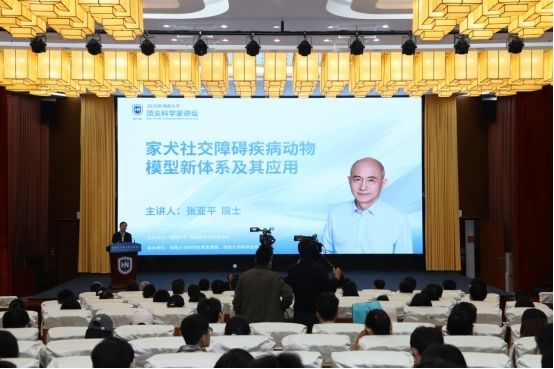
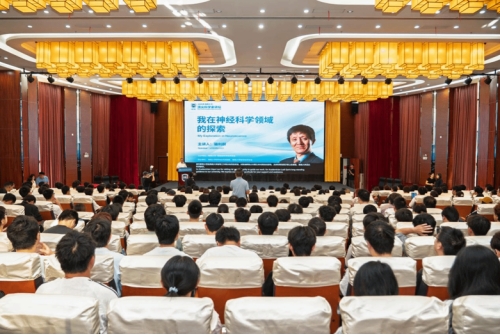
On the afternoon of November 12, the 71st session of the Hainan University Distinguished Scientist Lecture Series was held in the lecture hall on the second floor of Tian Jiabing Building. Sun Changpu, Academician of the Chinese Academy of Sciences and founding Dean of the Graduate School of the China Academy of Engineering Physics, delivered a lecture titled Why Science in the Context of Artificial Intelligence? — A Transformation of the Research Paradigm Based on the Dual Canonicalization of Knowledge Generation. Ye Zhaohui, Academician of the Chinese Academy of Sciences and researcher at the Innovation Academy for Precision Measurement Science and Technology, Chinese Academy of Sciences, and Luo Qingming, Academician of the Chinese Academy of Sciences and President of Hainan University, attended the lecture.
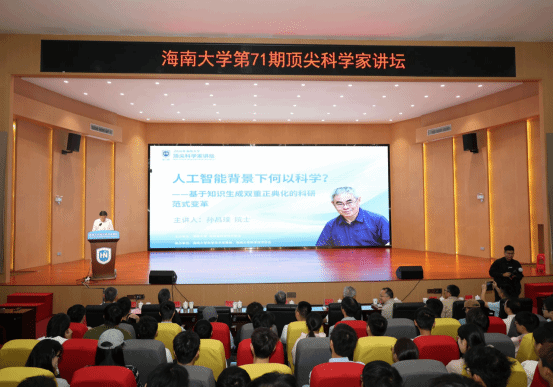
The 71st Distinguished Scientist Lecture is held in Tian Jiabing Building on the afternoon of November 12. (Photo by Xie Guiqing)
Starting from the impact of artificial intelligence on mathematics, Prof. Sun Changpu explained the meaning of the canonicalization of scientific knowledge and analyzed the safety risks arising from the black-box nature of artificial intelligence. He traced nearly seven decades of AI evolution toward a technological singularity, and systematically reviewed research advances in AI safety. By drawing interdisciplinary comparisons across molecular biology, mathematics, and physics, Prof. Sun explored the shifts in research paradigms and evaluation mechanisms accelerated by AI and proposed a dual-canonicalization analytical framework. Combining his own research and teaching practice, he also shared with the faculty and students his thoughts on and experience in integrating education, talent, and science and technology in the AI era.
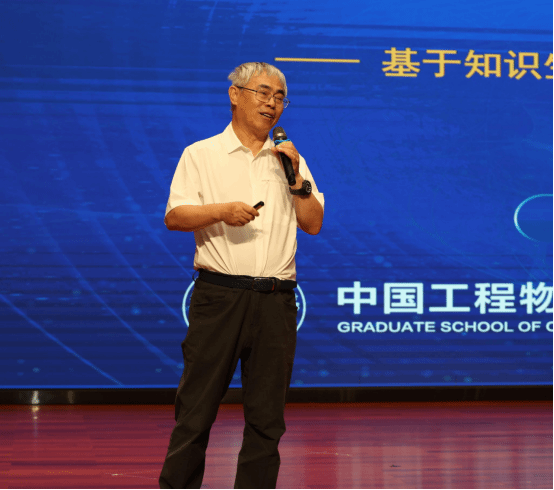
Sun Changpu delivers the lecture. (Photo by Wu Linyi)
Prof. Sun Changpu pointed out that AI’s impact is reflected not in a threat to the foundations of academic disciplines themselves, but in the value alienation that occurs when partial outputs replace a discipline’s fundamental goals. Meanwhile, AI has brought a stark tension to the fore: while AI has reshaped the knowledge production model of scientific research, greatly improving the efficiency of model building, mathematical derivation, and numerical computation, our capacity for scientific verification and knowledge canonicalization remains comparatively underdeveloped. Canonicalization of research findings is intended to incorporate verified discoveries into a cumulative body of public knowledge, while meta-canonicalization of AI tools serves to calibrate the errors and applicable boundaries of AI models, algorithms, and workflows, thereby providing a basis for trustworthy use. He emphasized the close interrelationship between the canonicalization of research findings at the object level and the meta-canonicalization of research tools at the tool level, with each subject to its own verification requirements and both contributing to the formation of reliable knowledge. The future development of artificial intelligence must move toward verifiable science, and the scientific spirit in the AI era lies precisely in upholding fundamental principles while breaking new ground and adhering to the core values of science.
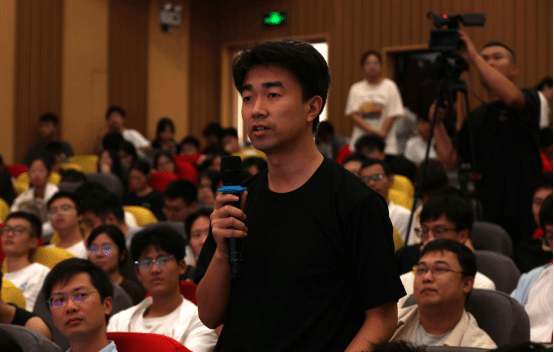
Q&A Session (Photo by He Yang)
During the interactive session, faculty and students actively raised questions on how to leverage artificial intelligence to enhance learning outcomes and how to use artificial intelligence to carry out scientific research. Prof. Sun answered each question in detail, sharing cutting-edge insights and his research experience.
The lecture attracted both on-site and online participants from the Hainan Association for Science and Technology, relevant academic societies, and science and technology associations affiliated with enterprises and universities. Also in attendance were heads of relevant HNU units and departments, as well as faculty and student representatives from its four campuses: Haidian, Danzhou, Mission Hills (including the Chengxi Teaching Site), and Yazhou.
Translated by Zhong Feiyang
Proofread by Feng Jun