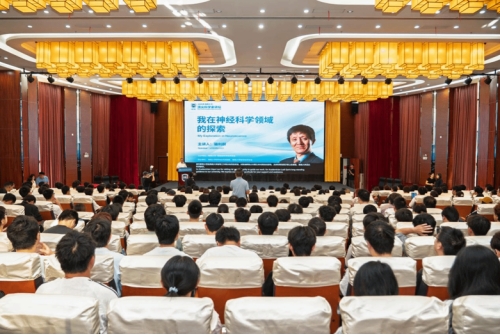
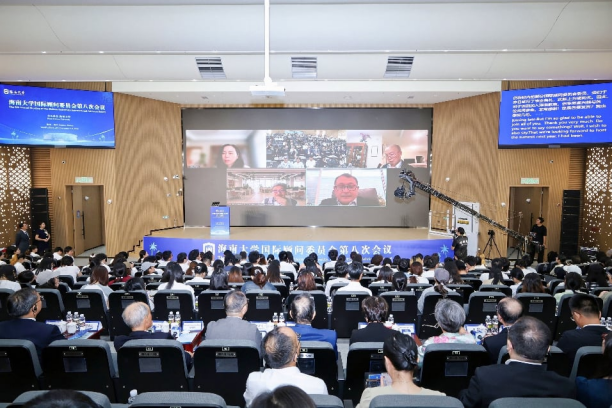
On November 3, 2026, the 68th session of Hainan University’s Distinguished Scientist Lecture Series was held in the Mingde Building, Haidian Campus, chaired by Vice President Chen Jun.
Dr. Yu Guirui, Academician of the Chinese Academy of Sciences (CAS) at the Institute of Geographic Sciences and Natural Resources Research, CAS, delivered a lecture titled “The Development and Mission of Ecology and Ecosystem Science.”
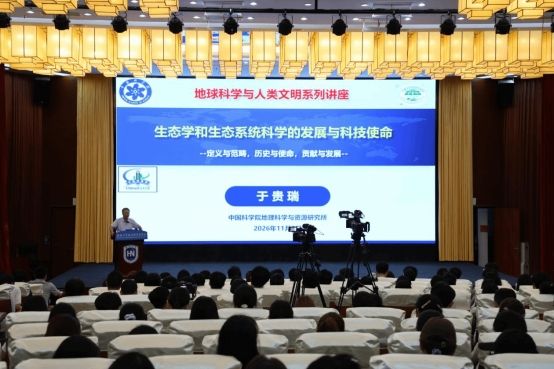
The 68th session of Hainan University’s Distinguished Scientist Lecture Series is held on November 3, 2026.
Yu traced the origins of ecology from humanity’s pursuit of knowledge and the formation of modern science. He showed how the ecosystem concept advanced ecology from a classical discipline to a comprehensive, macro-level ecosystem science, fostering the integration of biology, geography, environmental science, and socio-economics.
He noted that ecology and ecosystem science are emerging disciplines that continually evolve, iterate, and converge in response to the scientific and technological needs of human civilization.
Modern ecology has transcended traditional life science to address the fundamental question of ecological relationships among humans, organisms, life, and the environment. This renewed convergence of natural and human ecology is giving rise to ecological earth science—a frontier interdisciplinary paradigm.
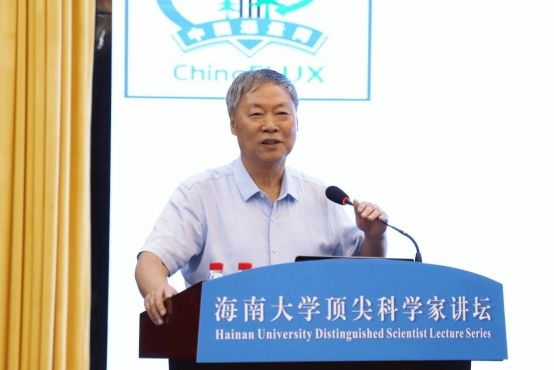
Academician Yu Guirui at the 68th session of Hainan University’s Distinguished Scientist Lecture Series on November 3, 2026
Yu stated that ecosystem science must deepen integrated research on ecosystem structure, processes, functions, and services. He noted that such research is key to tackling global climate change, biodiversity loss, and ecosystem degradation, and to supporting carbon neutrality, ecological protection and restoration, and national ecological security.
He added that future research should strengthen integrated studies through multi-source data analysis, multi-model cross-scale simulation, and multidisciplinary integration.
To achieve this, the integrated technical framework must be improved—combining networked observation, networked experiments, numerical simulation, and knowledge integration—to expand ecosystem science toward predictive modeling and ecological governance decision-making.
During the Q&A session, faculty and students actively raised questions on a range of topics. These included the Kunmai Project (a new-generation national infrastructure for ecosystem carbon cycle and ecological critical zone observation and experimentation), the relationship between AI technology and ecological research, and frontier research pathways for water use efficiency in relation to photosynthesis and transpiration. Yu responded to each question in detail, sharing cutting-edge perspectives and research experience.
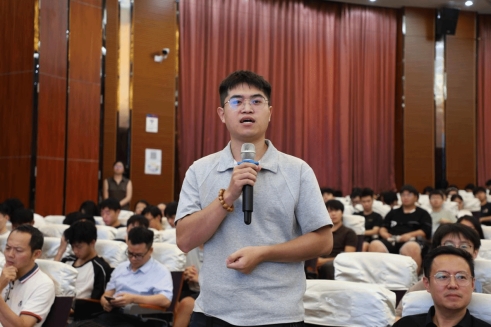
Q&A session at the 68th session of Hainan University’s Distinguished Scientist Lecture Series on November 3, 2026
The event was held both online and offline. Attendees included relevant administrators from Hainan University and faculty and student representatives from its campuses of Haidian, Danzhou, Mission Hills (including Chengxi Teaching Site), and Yazhou. Also present were representatives from the Hainan Provincial Association for Science and Technology, relevant academic societies, and science and technology associations in enterprises and higher education institutions.
Translated by She Wenhao
Proofread by Jin Ying